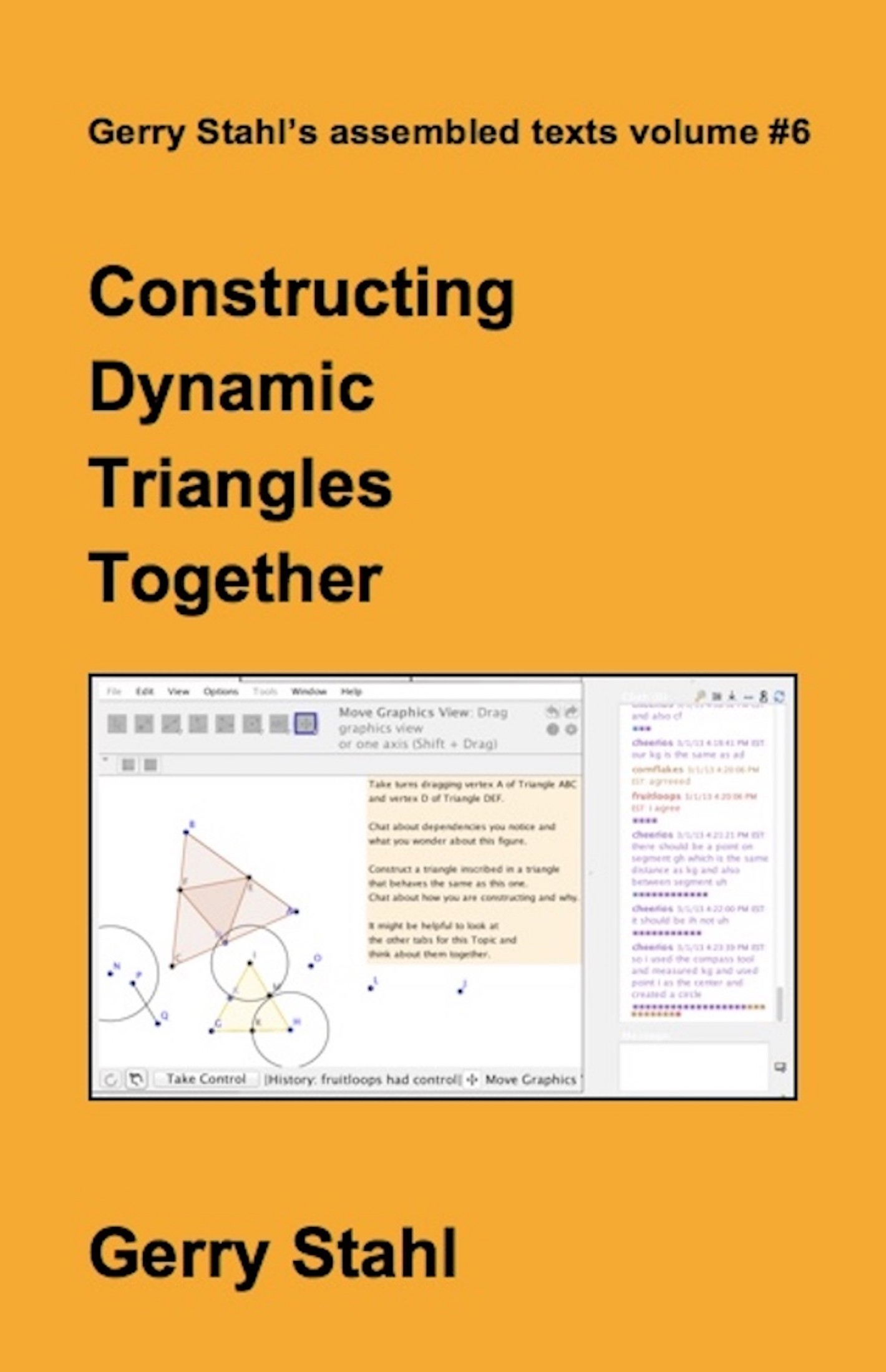
Volume 6. Constructing Dynamic Triangles Together: The Development of Mathematical Group Cognition
Constructing Dynamic Triangles Together: The Development of Mathematical Group Cognition is an extended longitudinal case study of three eighth-grade students learning dynamic geometry collaboratively in an online environment. Over eight hour-long sessions, the team — referred to as the Cereal Team after the online names its members chose — explores, constructs, and discusses geometric figures in a multi-user version of GeoGebra integrated into the Virtual Math Teams (VMT) text-chat environment. The book's central claim is that genuine mathematical cognition in this context is not an individual achievement but a group process: knowledge, skills, and understanding emerge from the sequential interaction of team members and cannot be attributed to any one participant alone.
The book is structured to mirror the team's developmental trajectory. Three introductory chapters establish the research context, historical background, and methodological framework. Eight analysis chapters follow the team session-by-session, each foregrounding one dimension of the team's development: collaboration practices in Session 1, dragging practices in Session 2, construction practices in Session 3, tool-usage practices in Session 4, dependency identification across Sessions 5 and 6, transformation tools in Session 7, and mathematical discourse and action practices in Session 8. Two concluding chapters synthesize the findings theoretically and develop an account of mathematical group cognition as a dialectical, probabilistic, and interactionally distributed process.
The concept of group practice is the book's primary analytical unit. A group practice, as the analysis defines it, is a pattern of interaction that the team adopts collectively — through explicit agreement, repeated use, and the gradual building of shared expectations — and that then functions as a resource enabling further development. The analysis enumerates dozens of such practices across the eight sessions, organized by dimension: collaboration practices (how to coordinate turn-taking and control of the shared interface), dragging practices (how to use movement of points to explore geometric properties and test constructions), construction practices (how to build figures by imposing constraints rather than arranging objects visually), tool-usage practices (how to use GeoGebra's standard and custom tools effectively), dependency-related practices (how to identify, describe, and construct the dependencies that define dynamic-geometry figures), and mathematical discourse practices (how to articulate geometric relationships in language that the team can use to coordinate action and reasoning).
The concept of dependency is the mathematical core around which all other development is organized. In dynamic geometry, a dependency is a relationship built into a construction such that when one element of the figure is moved, other elements move in determined ways that preserve the relationship. Understanding dependencies — how they arise from construction, how they can be identified through dragging, how they can be designed into new constructions — is the book's central pedagogical goal. The team's progress toward this understanding is gradual, uneven, and marked by characteristic difficulties: early in the sessions, students routinely confuse visual resemblance (drawing) with constructed dependency (construction), treat dragging as a test of visual appearance rather than as a probe of underlying structure, and struggle to articulate what makes a point free, restricted, or dependent. By the final session, the same team investigates a set of unfamiliar quadrilaterals with confidence, using dragging systematically to identify dependencies and inferring how each figure must have been constructed from its observed dynamic behavior.
Several chapters are particularly tightly connected. Sessions 5 and 6 — the inscribed triangles and squares problem — form the analytical centerpiece of the book, receiving the most detailed interaction analysis and generating the largest number of explicitly enumerated group practices. The problem of constructing a figure whose relationships are preserved under dragging requires the team to integrate everything they have learned about dragging, construction, and dependency, and the analysis of these sessions most fully demonstrates what mathematical group cognition looks like in practice. Session 8, the final session, then functions as a summative assessment, showing how the team applies its accumulated practices and understanding to new material.
The theoretical synthesis in the final two chapters draws on the session analyses to make several contributions to the broader study of collaborative learning. The concept of group agency — the capacity of a team to direct its own mathematical inquiry without depending on direct teacher intervention — is shown to develop in parallel with the team's mathematical competence, as the students become increasingly able to initiate, sustain, and evaluate their own explorations. The analysis of dragging as embodied cognition connects the physical act of moving a point through the GeoGebra interface to the development of geometric understanding, showing how the body's engagement with the software mediates cognition in ways that purely symbolic or verbal approaches cannot. And the concept of the probabilistic nature of group knowledge — the idea that what a group "knows" is not a fixed possession but a varying capacity to respond to new challenges — offers a distinctive alternative to both individualist accounts of learning and sociological accounts of community knowledge.
Read as a whole, the book makes a case that is both empirical and programmatic: empirical, in that it documents in fine-grained detail how one team's mathematical group cognition actually developed; and programmatic, in that it argues for the design of educational environments, technologies, and curricula that make this kind of development possible for more students. The Cereal Team's trajectory — from uncertain, individually-oriented beginners to a confident, collaboratively-reasoning group — is offered as both a description of what collaborative mathematics learning can look like and a model for the kind of learning that computer-supported collaborative environments should be designed to support.
* Download PDF free for reading online or printing: analysis.pdf
(This is the best version: up-to-date, complete, full color, hi-res.)
* Download iBook version free for iPad, Mac, etc.: analysis.epub
* Download MOBI version free for Kindle: analysis.mobi
* Order paperback from Lulu at printing cost: Lulu page for Gerry Stahl
* Order paperback from Amazon at printing cost: Amazon page for Gerry Stahl
Introduction to the Analysis
This opening chapter introduces the book's subject and situates it within the Virtual Math Teams (VMT) Project's broader research program. The book presents an extended case study of three eighth-grade students — referred to as the Cereal Team — who worked together in eight hour-long online sessions using a multi-user version of GeoGebra integrated into the VMT chat environment. The team's task was to learn the fundamentals of dynamic geometry by exploring, constructing, and discussing geometric figures and their dependencies. The introduction explains that this volume is the culminating publication of the VMT Project, following earlier books that established the theoretical framework of group cognition, described the technology and research environment, and situated the project historically and mathematically. What distinguishes this book is its longitudinal scope: rather than analyzing brief excerpts from many groups, it follows one team through its complete eight-hour trajectory, documenting how mathematical group cognition develops over time. The chapter identifies the book's relevance across four fields: computer-supported collaborative learning, human-computer interaction, mathematics instruction, and educational technology.
Researching Mathematical Cognition
This chapter provides the intellectual and historical context for the study of mathematical cognition as a collaborative, culturally mediated achievement. The chapter traces the development of mathematical thinking from the ancient Greek geometers, who created a new form of discourse — combining constrained language, lettered diagrams, and deductive proof — as a distributed community practice, through the modern crisis in the foundations of mathematics and science. It reviews foundational research on the cognitive development of mathematical thinking, including work showing that the transition from visual, practical arithmetic to the abstract, relational reasoning required by geometry represents a watershed moment for many learners. The chapter then frames the VMT Project's approach: collaborative learning in small groups, mediated by dynamic-geometry software and online text chat, as a means of supporting the kind of enculturation into mathematical thinking that formal schooling often fails to provide. Analysis of the Cereal Team's interaction is grounded in close reading of chat logs coordinated with recordings of GeoGebra activity, tracking the team's meaning-making processes as they adopt mathematical group practices over the eight sessions.
Analyzing Development of Group Cognition
This methodological chapter establishes the analytical framework used throughout the book. Group cognition is defined not as a property that a group possesses but as a process through which individual members interact, contributing to shared knowledge-building that exceeds what any individual could achieve alone. The chapter argues that collaborative learning mediates between individual cognition and community knowledge, with small-group interaction serving as the site where community resources are taken up, negotiated, and individuated as personal skills. The primary analytical unit is the group practice: a pattern of interaction that the team adopts, stabilizes, and applies across sessions. Individual episodes become practices through the team's repeated use of and explicit agreement on them. The chapter describes the VMT Project's four primary research goals — improving collaboration, increasing productive mathematical discourse, supporting tool use, and developing understanding of dynamic dependencies — and explains how the analysis of each session focuses on one dimension of the team's development while acknowledging the interdependence of all four. The longitudinal scope allows the analysis to document not just whether learning occurred but how it unfolded through specific interactional mechanisms.
Session 1: The Team Develops Collaboration Practices
This chapter analyzes the Cereal Team's first session, focusing on how three students who know each other from school but have not collaborated in an online mathematical context establish the group practices needed to work together effectively in the VMT environment. The students begin with no shared sense of how to interact in this medium — who should control the GeoGebra interface, how to coordinate turn-taking in chat, how to follow the curriculum instructions — and must negotiate each of these dimensions from scratch. The chapter traces a sequence of episodes in which the team progressively resolves these uncertainties and stabilizes a set of collaboration practices: following the numbered steps in the instructions, taking turns at control of GeoGebra, checking for agreement before moving on, and building on each other's contributions rather than working in parallel. The analysis draws on theories of joint intentionality to explain how this process parallels, in compressed form, the evolutionary development of distinctively human collaborative capacities: the students must simultaneously maintain individual perspectives and joint attention toward shared goals.
Session 2: The Team Develops Dragging Practices
This chapter analyzes the Cereal Team's second session, in which they work on constructing an equilateral triangle in GeoGebra — the foundational construction of Euclidean geometry. The session reveals that learning to work in dynamic-geometry software requires extensive trial and exploration before students can follow even carefully stated instructions. The team spends considerable time constructing points, segments, and circles without clear planning, discovering through exploration rather than deduction how the tools behave. The chapter identifies a set of group dragging practices adopted during this session: using two points to define a line or segment, dragging vertices to test the behavior of a figure, recognizing when a construction has failed by observing that dragging destroys the intended relationship, and sharing observations from dragging through chat before taking further construction steps. These practices are shown to be group achievements — not skills any one student possessed individually — that emerge from the team's coordinated interaction and become stable resources for subsequent sessions.
Session 3: The Team Develops Construction Practices
This chapter examines the Cereal Team's third session, centered on the construction of perpendicular bisectors and perpendicular lines — geometric relationships that demand understanding the difference between a visual drawing and a theoretical dynamic-geometry construction. The chapter introduces this distinction as the conceptual core of dynamic geometry: a drawing is any configuration of objects that looks like the intended figure, while a construction is a figure in which the intended relationships are encoded as dependencies so that they are preserved under dragging. The team is shown to be transitioning between two production routines: visual placement (arranging objects to look right) and constraint-based construction (building relationships that guarantee the figure's properties). This transition corresponds to a well-documented progression in mathematics education from visual recognition of shapes to relational understanding of their properties. The team's progress through this transition is uneven and nonlinear — students oscillate between the two approaches depending on the task — but the session marks a qualitative shift in how the group understands and discusses geometric figures.
Session 4: The Team Develops Tool-Usage Practices
This chapter analyzes the Cereal Team's fourth session, focused on the construction of right triangles, isosceles triangles, and a hierarchy of triangle types using GeoGebra's custom-tool feature. Custom tools allow users to encapsulate a construction — defining the steps and constraints that produce a particular figure — and save it as a reusable icon in the GeoGebra toolbar. Working with custom tools requires students to think about the construction process as an object: not just what the finished figure looks like but what relationships among its parts were imposed to produce it. The chapter identifies several group tool-usage practices adopted during this session, including using two points to define a line, applying perpendicular-line tools correctly, testing constructions with the drag test, and distinguishing free from dependent points by attempting to drag them. The chapter also examines how the task of assembling a hierarchy of triangle types — organizing equilateral, isosceles, right, and scalene triangles into a logical structure based on their constraint relationships — pushes the team toward more explicitly relational mathematical discourse.
Session 5: The Team Identifies Dependencies
This chapter presents the most detailed interaction analysis in the book, covering the Cereal Team's fifth session and part of their sixth, in which they work on a problem of inscribed equilateral triangles and squares. The team is asked to explore, explain, and then reconstruct a figure in which an equilateral triangle is inscribed inside another equilateral triangle such that both triangles remain equilateral and inscribed when any vertex is dragged. The session is divided into three phases — exploratory dragging, experimental constructing, and determination of dependencies — each of which is analyzed in close sequential detail. The chapter enumerates a series of group dependency-related practices adopted during this session: dragging vertices to explore invariants, observing which points can and cannot be moved, noticing how movement of one point causes movement of others, and using the color coding of GeoGebra points (free, restricted, or dependent) as evidence about the construction. The team's gradual development of a concept of dependency — from observational ("it can't go beyond the triangle") to structural ("because we made it through the compass, the circle is still there but hidden") — is traced through the chat log.
Session 6: The Team Constructs Dependencies
This chapter continues the analysis of the Cereal Team's work on the inscribed polygons problem, focusing on Session 6, in which the team returns to Topic 5 and is tasked with explaining their successful construction of the inscribed equilateral triangles to their class, and then attempting to construct inscribed squares using the same principles. The session opens with the team reconstructing their own reasoning aloud in the chat — explaining each construction step and its rationale — which functions both as a report to the teacher and as an opportunity for the team to consolidate and refine their understanding. This metacognitive reflection on their own construction process produces additional dependency-related practices: articulating why specific points are restricted or dependent, connecting GeoGebra's visual color coding of points to the underlying construction history, and using formal mathematical vocabulary to describe geometric relationships. The team then applies their understanding of the inscribed-triangles construction to the new challenge of inscribed squares, demonstrating transfer of the dependency-reasoning skills developed in the prior session, though requiring substantial further effort and exploration.
Session 7: The Team Uses Transformation Tools
This chapter analyzes the Cereal Team's seventh session, in which their teacher assigned a topic on rigid geometric transformations — translation, rotation, and reflection — using GeoGebra's transformation tools. Transformations introduce a new and distinct model of dependency: rather than constructing a figure by imposing constraints on its parts, transformations produce new dependent figures from existing ones, with all properties of the original automatically inherited by the transformed copies. The team explores how dragging the original triangle or the translation vector causes all dependent triangles to move correspondingly, discovering that the dependent triangles cannot be directly manipulated. The chapter notes that a single session proved insufficient to develop a clear grasp of the transformation paradigm, particularly because the topic involved several different types of transformation in one tab. The team's interaction during this session is less sustained and productive than in earlier sessions, suggesting that the scaffolding and pacing of the curriculum unit on transformations did not adequately support the depth of engagement the team had achieved with the dependency-construction approach. Nevertheless, the session extends the team's repertoire of group dragging practices.
Session 8: The Team Develops Mathematical Discourse and Action Practices
This chapter analyzes the Cereal Team's eighth and final session, which serves as a partial summative assessment of their development. The task — investigating the dependencies of a set of pre-constructed quadrilaterals — requires the team to apply all the skills developed across the previous sessions: exploratory dragging, identification of free and dependent points, inference of construction process from observed behavior, and articulation of dependency relationships in mathematical language. The chapter documents a striking contrast with Session 1: the team now begins immediately and efficiently, takes turns with confidence, uses geometric vocabulary correctly, and attributes the observed behavior of figures to their construction process rather than their visual appearance. The analysis identifies a final set of group mathematical discourse and action practices adopted in this session, including using dragging as a referential resource for making meaning — coordinating the act of dragging a point with a chat posting that describes the resulting movement to make a mathematical claim accessible to the whole team. The session demonstrates that the team has developed what the chapter calls mathematical group cognition: the capacity to collaboratively investigate, discuss, and reason about geometric relationships in dynamic-geometry figures.
Contributions to a Theory of Mathematical Group Cognition
This chapter synthesizes the findings of the eight-session analysis into theoretical contributions to the study of mathematical group cognition. The chapter is organized around six dimensions that guided the analysis throughout: collaboration and group agency, the discourse of mathematical dependency, dynamic-geometry tools as mediators of cognitive development (with sub-dimensions of dragging as embodied cognition, constructing as situated cognition, and designing as conceptualizing dependency). For each dimension, the chapter develops a conceptual contribution: group agency as the capacity of a team to direct its own mathematical inquiry; dependency discourse as the specific form of mathematical language that makes dynamic-geometry relationships visible and discussable; tool mediation as the way in which GeoGebra's dragging, construction, and design tools structure and support mathematical cognition at the group level; embodied cognition as the physically enacted exploration of geometric properties through dragging; and situated cognition as the dependence of mathematical understanding on the specific history of prior constructions and interactions. The chapter argues that the development of group cognition is best understood as the progressive adoption of group practices across these dimensions.
Constructing Dynamic Triangles Together
The concluding chapter reflects on the deeper theoretical implications of the book's findings, developing an account of group cognition as a dialectical process rather than a property or state. Group cognition is characterized as a dialectic in which the group and its individual members mutually constitute each other: the group is nothing more than its interacting members, yet individual actions are so deeply shaped by the interactional context that they cannot be attributed to the individual alone but must be understood as products of the group process. The chapter introduces the concept of the probabilistic nature of group knowledge: what a group "knows" at any moment is not a fixed set of propositions but a varying probability that the group will be able to respond appropriately to new challenges, given its accumulated practices and skills. The chapter traces the implications of this view for learning theory, arguing that mathematical cognition is not a possession of either individual minds or groups but an ongoing interactional achievement distributed across participants, tools, and the shared history of their interaction. The book ends by affirming the promise of computer-supported collaborative learning to support this kind of distributed mathematical cognition at scale.