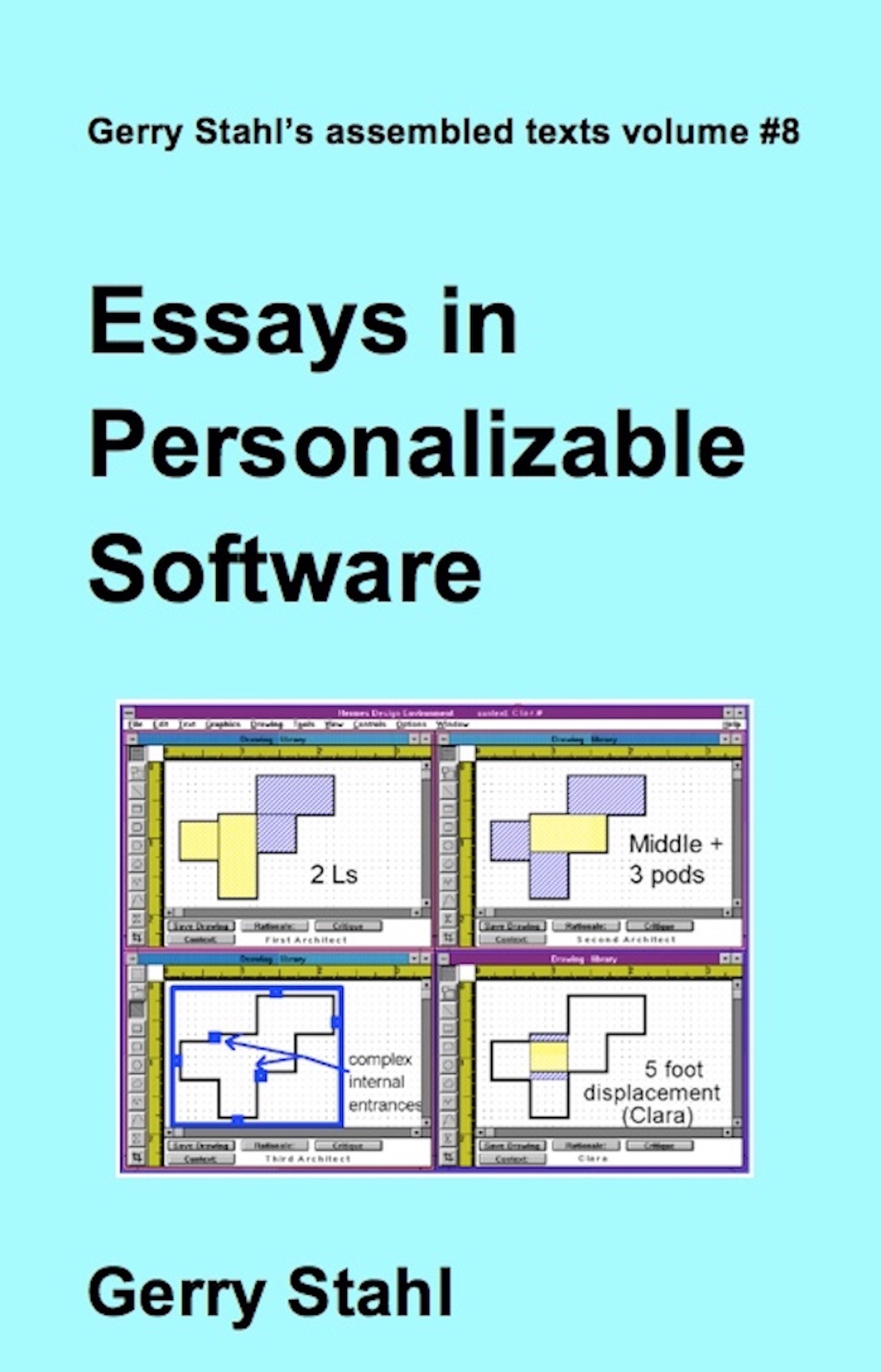
Volume 8. Essays in Personalizable Software
Essays in Personalizable Software collects eighteen papers spanning roughly two decades of research on a coherent set of problems at the intersection of software design, learning science, and computer-supported collaborative work. The central preoccupation is personalization: how can software mediate between the universal, decontextualized representations that computational systems require and the personal, situated needs of individual learners and designers? The collection traces several interlocking lines of inquiry in pursuit of this question, moving from foundational theory through prototype systems to applied studies of collaborative learning in diverse settings.
The first cluster of essays (chapters 1-3) establishes the intellectual foundations. Frustrated with rule-based expert systems that force rigid formal representations on domains where human interpretation is essential, these papers develop a hypermedia inference language and the prototype system Hermes. Grounded in the hermeneutic philosophy of Heidegger, the theory of hermeneutic software design proposes that software should function as an active external memory for human interpretation — not a replacement for it. The key concepts introduced here — perspectives, critics, end-user programming languages — recur throughout the book and give it its theoretical unity.
The next cluster (chapters 4-6) translates these ideas into proposals for personalizable learning software. The book envisions dynamic hypertext that restructures itself to match a learner's interests, a Teacher's Curriculum Assistant to help educators locate and adapt curriculum, and web-based mechanisms for both personalizing information and reseeding personal adaptations back into community repositories. Chapter 5's analysis of the fundamental contradiction of the web — that universal access requires decontextualized formats, while learning requires personalized presentation — gives the sharpest theoretical formulation of the problem the entire collection addresses.
Critics — computational agents embedded in design environments to provide timely, domain-relevant feedback — are examined in detail in chapters 7 and 8. Together these papers argue that critics are effective only when embedded in design environments where they can exploit knowledge of the design domain, the partial specification, and the designer's interpretive perspective. The three types of embedded critics — generic, specific, and interpretive — are positioned as complementary, each addressing a different dimension of design knowledge. The concept of a "symmetry of ignorance" in complex design — where no individual can know everything relevant — grounds the argument for computational critics as distributors of relevant knowledge.
Chapters 9-11 develop the theory and implementation of perspectives in collaborative settings, culminating in the proposal to intertwine perspectives with negotiation mechanisms. The POW! perspectives server and WebGuide both implement the idea that individuals need personal perspectives on shared information while also requiring mechanisms for group perspective-taking. The crucial theoretical contribution is the argument that perspectives and negotiation offset each other's weaknesses: perspectives enable work to continue while negotiation proceeds, and negotiation provides the convergence that isolated perspectives cannot achieve on their own.
The remaining chapters extend these frameworks to diverse real-world domains. Chapter 12 brings CSCW and CSCL findings to bear on collaborative care in hospital settings, with characteristic candor about the systematic failures of software support for group work. Chapters 13 and 14 address the design of Internet repositories — for classroom collaboration (chapter 13) and for scholarly peer review (chapter 14) — each finding that users do not automatically use designed affordances as intended. Chapters 15 and 16 present empirical studies of specific collaborative tools: LSA-based summarization feedback (Summary Street) and game-based collaborative learning environments. Chapters 17 and 18 frame the collection's concerns within the broader discourse of learning communities and cooperative learning.
Several themes persist across the collection. The tension between universal representations and personal needs is the animating problem. The critique of AI systems that automate rather than support human interpretation runs from chapter 1 to chapter 17. The complementary roles of individual and group perspectives — and the need for software that supports both simultaneously — appear in almost every chapter after the third. The iterative, user-centered character of effective software development, and the social and organizational barriers that frustrate even well-designed systems, recur as practical lessons throughout the applied studies. Together the essays constitute both a sustained critique of AI-centric approaches to design support and learning, and a constructive research program for software that genuinely serves the interpretive, social dimensions of human work and learning.
* Download PDF free for reading online or printing: software.pdf
(This is the best version: up-to-date, complete, full color, hi-res.)
* Download iBook version free for iPad, Mac, etc.: software.epub
* Download MOBI version free for Kindle: software.mobi
* Order paperback from Lulu at printing cost: Lulu page for Gerry Stahl
* Order paperback from Amazon at printing cost: Amazon page for Gerry Stahl
A Computational Medium for Supporting Interpretation in Design
This chapter introduces Hermes, a prototype system for supporting the design of lunar habitats, and uses it to argue for a new paradigm of computational support for design. The chapter draws on Alexander, Rittel, and Schoen to show that pivotal theories of design methodology conflict fundamentally with classical AI: computation should not replace human intuition, impose closed frameworks, or restrict the interpretive perspectives through which designers construct design situations. Hermes responds with a unified hypermedia knowledge representation system incorporating a special language for defining terms, conditions, critics, and queries, organized around hierarchies of personal and group interpretive perspectives. The chapter argues that effective design support requires a computationally active medium for expressing, storing, communicating, and critiquing interpretations — one that enhances human creativity rather than automating the design process.
Toward a Theory of Hermeneutic Software Design
This chapter proposes a theoretical framework for hermeneutic software design grounded in the philosophy of Heidegger. Four successive stages of human cognition are distinguished: disclosing the world in which one is situated; using things tacitly; explicitly interpreting something in a particular way; and analyzing things theoretically with formal methods. Each stage can be computationally supported — through graphical world modeling, direct manipulation, end-user language, and formal computation respectively. Design is conceptualized as a tentative, risky process in which a designer creates a new world, explores its possibilities, resolves conflicts, and interprets significances. The Hermes prototype embodies this theory through integrated graphics, textual commentary, group and personal perspectives, and formal computation — functioning as a multi-media external memory for design teams that leaves interpretation entirely to the human user.
Supporting Personalizable Learning
This chapter outlines a research agenda for computer-based approaches to personalizable learning. It proposes two prototype systems: a Teacher's Curriculum Assistant (TCA), which allows educators to locate, adapt, and share curriculum resources from digital libraries, and a Personalizable Learning Medium (PLM), which allows learners to explore educational resources tailored to their personal interests and needs. The chapter surveys diverse pedagogical theories — from constructivism to situated learning — to argue that personalization is central to effective learning. The vision includes dynamic hypertext that restructures itself in response to learner queries and preferences, as well as shared repositories enabling collaboration across schools. The chapter also identifies broader issues for a theory of personalizable software, including delegation, adaptation, and the representation of personal interests.
Personalizing the Web
This chapter identifies an essential contradiction in the World Wide Web: for information to be universally shared, it must be encoded in decontextualized, universalized formats; but information is most meaningful and useful when adapted to personal interests, backgrounds, and situations. Three mechanisms for bridging this gap are proposed: dynamic hypertext, in which computational hypertext restructures itself at runtime; personal perspectives, which filter and organize a shared information space around a user's conceptual context; and structural navigation, which guides browsing according to individual information needs. Five prototype systems illustrate these mechanisms across different applications. The chapter argues that a new generation of web servers and browsers is required to make the web interactive and personal, rather than a medium for passive consumption of publisher-driven content.
Supporting Personalization and Reseeding-on-demand
This short chapter describes three software systems that together illustrate the challenge of supporting both personalization and social sharing of knowledge. WebNet is a web-based design environment for LAN maintenance in which communities of designers share designs, rationale, and simulation artifacts, each personalizing the information space to local needs. The Teacher's Curriculum Assistant (TCA) supports teachers in locating, using, adapting, and sharing classroom resources — such as WebQuest games — from Internet repositories. The Collaborative Info Environment (CIE) captures email to build shared knowledge repositories without requiring explicit data entry. The chapter argues that learning is the personal construction of knowledge within a social context, and that software must support both the personalizing of shared resources and the reseeding of personal adaptations back into the community.
Embedding ComputerBased Critics in the Contexts of Design
This chapter examines the limitations of early stand-alone critiquing systems and introduces three classes of critics embedded in domain-oriented design environments. Generic critics apply domain knowledge to detect problematic situations during design construction. Specific critics exploit the design specification to identify inconsistencies between specification and construction. Interpretive critics are tied to perspective mechanisms, enabling designers to examine their artifact from alternative viewpoints. Early systems failed to say the "right" thing at the "right" time because they lacked domain orientation, could not justify suggestions, ignored user goals and individual perspectives, and had poor intervention timing. The chapter demonstrates, through examples from kitchen floor plan and other design domains, how embedding critics in their contexts of use makes critiques more focused, timely, and relevant.
Embedding Critics in Design Environments
This chapter provides a fuller theoretical account of embedded critics in design environments. It argues that human understanding in design evolves through critiquing — a dialog in which a reasoned opinion about a product triggers reflection and revision. Computer-based critics embedded in domain-oriented design environments serve three complementary functions: increasing designer understanding by flagging problematic situations early; integrating problem framing with problem solving through linkage between specification and construction; and helping designers access relevant information from large knowledge bases at appropriate moments. The three mechanisms — generic, specific, and interpretive critics — are described through detailed examples from HYDRA-kitchen. The chapter grounds the argument in the concept of a "symmetry of ignorance" in complex design: because no individual can know everything relevant, embedded critics distribute the knowledge needed to support the design process.
POW! Perspectives On the Web
This chapter presents POW! (Perspectives On the Web), a server-based system that provides individuals and groups with flexible mechanisms for organizing shared information repositories through personal and group perspectives. Drawing on the hermeneutic philosophy of Heidegger and Gadamer — for whom all understanding is perspectival — the chapter argues that collaborative learning is best understood as a dialectic between perspective-making and perspective-taking. POW! allows users to filter, annotate, and organize a shared repository within their own perspective without interfering with others' views, while also supporting the interplay between individual and group understanding. The system is tested in two educational contexts: a middle school environmental course and a graduate cognitive science seminar, and evaluation results are discussed.
Reflections on WebGuide: Seven Issues for the Next Generation of Collaborative Knowledge-Building Environments
Knowledge-Building Environments
This chapter reflects on experiences piloting WebGuide — a Knowledge-Building Environment featuring personal, group, and comparison perspectives — in a middle school science classroom and a graduate interdisciplinary seminar. Seven major issues for future work are identified, including: how to construct meaningful perspectives from threaded discussions; how to sustain student participation; how to integrate perspective mechanisms with substantive knowledge construction; and how to balance individual and group understanding. The chapter draws on a synthesis of collaborative learning theory and hands-on implementation experience to argue that computer-mediated collaboration holds extraordinary potential but faces enormous practical barriers. The seven issues are framed as an agenda for future development of knowledge-building environments, analogous to foundational open problems in hypermedia research.
Intertwining Perspectives and Negotiation
This chapter proposes that perspectives and negotiation, each valuable independently in computer-supported cooperative work, are most powerful when intertwined. Perspectives allow individuals to maintain personal views on shared information but produce divergence among group members. Negotiation can converge those views on shared understanding but delays ongoing work. By intertwining the two mechanisms — allowing work to continue in personal perspectives while negotiation determines shared group content — their mutual weaknesses are offset. WebGuide is the prototype system implementing this approach, allowing short segments from personal perspectives to be dynamically extracted from a shared information source and merged into a group product. The chapter presents the theoretical motivation, reviews related work in CSCW, and describes the WebGuide design in detail.
Reflections on Supporting and Studying Collaborative Team Formation in PostCardiac Surgery Care: Lessons of CSCW for Collaborative Care Software Support
Post-Cardiac Surgery Care
This chapter applies findings from the fields of Computer-Supported Cooperative Work (CSCW) and Computer-Supported Collaborative Learning (CSCL) to the challenge of supporting collaborative team formation in post-cardiac surgery care. Key findings surveyed include: that software support often fails; that first implementations should be expected to be discarded; that user-centered design requires involving users from the outset; that existing tacit procedures are easily disrupted by new systems; and that adoption depends heavily on organizational culture and structure. On this basis the chapter sketches a software development proposal for collaborative care support and a study plan for evaluating its introduction. The chapter is notable for its candid account of the systematic limitations of computer support and its insistence on iterative, ethnographically informed design.
Internet Repositories for Collaborative Learning: Supporting both Students and Teachers
and Teachers
This chapter argues that most computer-supported collaborative learning environments focus on students while neglecting teachers, limiting their ability to produce widespread educational change. For collaborative learning to succeed at scale, student collaboration tools must be integrated with curriculum development resources for teachers. The chapter describes two systems: the Remote Exploratorium (RE), which supports students and teachers in collaborating around interactive simulations of scientific phenomena, and the Teacher's Curriculum Assistant (TCA), which supports teachers in locating, using, adapting, and sharing curriculum resources from Internet repositories. The chapter illustrates how these tools can be orchestrated into integrated classroom support, with fundamental collaborative activities — locating, using, adapting, and sharing — operating at both teacher and student levels.
Evaluating Affordance Short-circuits by Reviewers and Authors Participating in On-line Journal Reviews
in On-line Journal Reviews
This chapter presents a qualitative analysis of online interactions during the peer review process at JiME (Journal of Interactive Media in Education), an e-journal designed to promote open dialogue between reviewers and authors. JiME's distinctive artifact-centered design anchors discussion to specific sections of the submitted text, with sections and associated comments displayed side-by-side. The study finds that reviewers and authors frequently engaged in "affordance short-circuits" — patterns of interaction that bypassed the medium's designed affordances, circumventing the artifact-centered structure. Based on this analysis, a set of design and editorial interventions is recommended to better channel interactions through the medium's intended mechanisms. The findings speak broadly to how computer-mediated knowledge-building environments can fail when users do not adopt their intended affordances.
Developing Summarization Skills through the Use of LSABased Feedback
This chapter describes the development and classroom testing of Summary Street, an educational software system that uses Latent Semantic Analysis (LSA) to provide automated feedback on student summaries. The system evaluates whether a summary adequately covers the source content, flagging missing information, redundancy, extraneous material, and length issues. The chapter traces an iterative collaborative development process between researchers and classroom teachers, through multiple prototype versions, that progressively shaped the system into one viable for actual classroom use. Classroom trials demonstrate that LSA-based feedback enables extensive independent practice in writing and revising, freeing teachers for coaching, modeling, and individual instruction. The chapter emphasizes that Summary Street is designed to complement, not replace, classroom instruction.
Designing Collaborative Learning Environments using Digital Games
This chapter presents a model for designing socio-technical environments that promote collaboration in group learning activities, and describes a game-based environment built and tested on this model. The model specifies the interactions among participants, initial conditions, and shared workspace structure required to foster productive collaboration. A set of quantitative collaboration indicators is introduced to measure and analyze collaborative processes, complementing the design model and allowing teachers to evaluate student performance. The collaborative game was tested experimentally, revealing both strengths and weaknesses that guided ongoing development. Drawing on Activity Theory and theories of meta-cognitive skill development, the chapter argues for integrating design models with measurement tools as a way to produce effective, analyzable collaborative learning environments.
Introduction: Computer Support for Learning Communities
This introductory essay for a special journal issue traces the historical progression from computers as isolated, efficiency-oriented machines, to tools supporting individual users, to groupware for small collaborative teams, to the present concern with computer support for communities of practice. The essay argues that modern communities are learning communities — they evolve through collective knowledge building and the shifting participation of their members — and that the interplay of community membership and knowledge development is increasingly mediated by computer infrastructure. Computer support for learning communities raises intransigent social issues, not merely technical engineering challenges: existing institutional structures evolved to meet different needs, and adapting them to a knowledge society produces conflicts invisible to armchair designers. The papers in the special issue are presented as combining concrete empirical cases with scientific analysis of these real-world challenges.
Book review of Professional Development for Cooperative Learning: Issues and Approaches
and Approaches
This brief critical review of an edited volume on training K-12 teachers in cooperative learning methods argues that the book is self-undermining: it documents insights — that teachers must "live" cooperative learning rather than hear about it, that training must be non-traditional and participatory — while presenting them in the form of conventional didactic essays. The reviewer observes that the cooperative learning movement, once avant-garde, already feels archaic relative to the possibilities of computer-supported collaborative learning. While acknowledging that most classrooms remain pre-constructivist and that the lessons of cooperative learning are still needed, the review argues that the field must go qualitatively beyond a view of education oriented toward individual students, and that computer and Internet technologies open possibilities that cooperative learning approaches have barely begun to address.