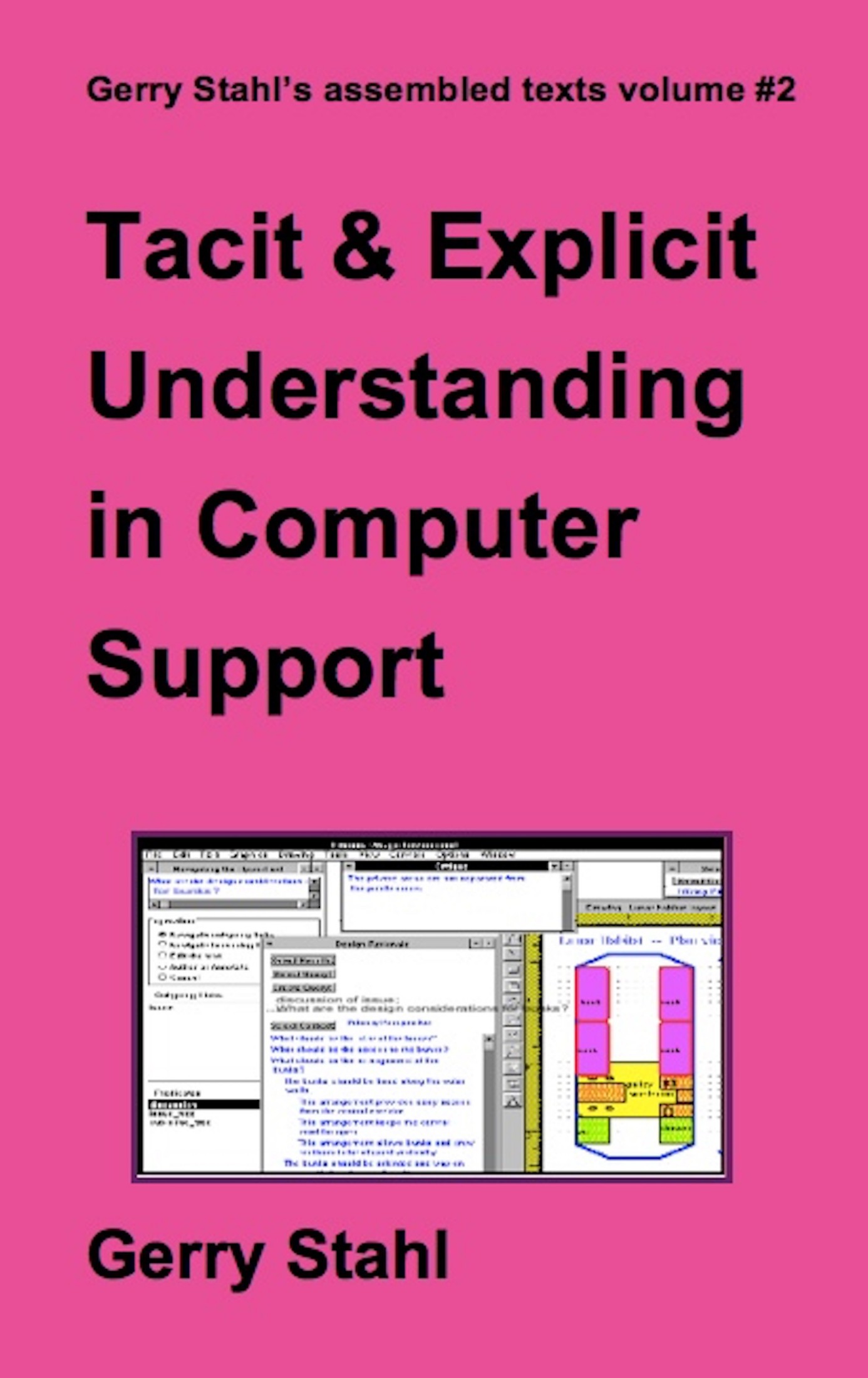
Volume 2. Tacit and Explicit Understanding in Computer Support
My computer science dissertation (1993) addresses a fundamental problem at the intersection of artificial intelligence and human-computer interaction: how can computer systems support innovative, collaborative design when the most important knowledge that designers bring to their work is tacit rather than explicit? I argue that the central impediment to computer support of innovative design is the gap between designers' reliance on situated tacit understanding and the computer's limitation to storing and displaying explicit representations. The title — Interpretation in Design — names both the central concept and the central challenge.
The dissertation unfolds as a hermeneutic spiral in its own right, moving from a vague preconception of interpretation in design to increasingly precise and operational articulations of the concept. Part I establishes the analysis of interpretation through three complementary investigations. A review of three design methodologists — Alexander, Rittel, and Schön — shows that the best available theories of design consistently recognize interpretation as irreducibly situated, perspectival, and linguistic, and consistently reject the automation of design. A protocol study of professional designers developing a lunar habitat for four astronauts provides concrete evidence that innovative design is driven by the emergence and operationalization of tacit concerns — in this case, the concept of a privacy gradient — that cannot be specified in advance by formal guidelines. Heidegger's hermeneutics provides the philosophical framework: all understanding is grounded in a tacit prepossession of the situation, focused by an interpretive perspective, and articulated in a linguistic preconception. The hermeneutic circle — that each act of interpretation both requires and revises preunderstanding — describes not a logical defect but the productive structure through which understanding advances.
Part II moves from analysis to theory and evaluation. Grounding explicit design knowledge in Heidegger's analysis requires addressing three fundamental problems that define the limits of what computer systems can do. The problem of intentionality shows that computers cannot ground symbols in the world the way human understanding does: symbols must remain in human interpretive control. The problem of application shows that understanding always involves situating knowledge in the current context — computers cannot perform this situating on behalf of designers. The problem of relevance shows that only humans embedded in design situations can judge what knowledge is pertinent. From these constraints, a theory of computer support is derived: systems must be people-centered, must provide a computationally active medium for representing the design situation, must support multiple interpretive perspectives organized by designers for their own purposes, and must offer an end-user language for articulating interpretations in domain vocabulary. A review of related systems — PHIDIAS, JANUS, KRL, PIE, and the design rationale languages — evaluates each against this theory, showing that while each contributes useful mechanisms, none provides theoretically adequate support for the full cycle of interpretation.
Part III presents HERMES as a prototype illustrating the theory. The HERMES substrate is a layered hypermedia knowledge representation system providing an active computational medium for all forms of design knowledge, with plasticity of representation — the ability of designers to modify and reorganize all information — as its central design principle. The perspectives mechanism enables designers to organize knowledge into overlapping, user-defined contexts with efficient virtual-copying inheritance, supporting both individual design work and collaborative sharing of knowledge across personal and group viewpoints. The HERMES end-user language allows designers to define interpretive critics, complex queries, and dynamic displays in domain vocabulary, suppressing traditional programming doctrine in tacit syntactic forms while maintaining expressive power sufficient for complex computational tasks. The privacy critics for lunar habitat design, developed across Chapters 9 and 10, demonstrate the synergy of all three mechanisms: critics are defined in the language using domain terminology, evaluated relative to the currently active perspective, and made available for collaborative reuse through the perspectives mechanism.
The dissertation's significance lies in its demonstration that a coherent philosophical theory — Heidegger's hermeneutics — can be applied rigorously to motivate and justify design decisions in computer systems for innovative design. This produces a qualitatively different approach to computer support: not expert systems that automate interpretation, but people-centered tools that augment human judgment, empower designers to control and evolve the computational environment in which they work, and support the collaborative development of shared design knowledge from multiple interpretive perspectives. Computer technology, the dissertation concludes, can contribute to human emancipation precisely by keeping control in human hands — by providing computationally active media of external memory that extend cognitive capabilities while preserving the interpretive freedom essential to creative design.
* Download PDF free for reading online or printing: tacit.pdf
(This is the best version: up-to-date, complete, full color, hi-res.)
* Download iBook version free for iPad, Mac, etc.: tacit.epub
* Download MOBI version free for Kindle: tacit.mobi
* Order paperback from Lulu at printing cost: Lulu page for Gerry Stahl
* Order paperback from Amazon at printing cost: Amazon page for Gerry Stahl
This dissertation addresses a fundamental problem at the intersection of artificial intelligence and human-computer interaction: how can computer systems support innovative, collaborative design when the most important knowledge that designers bring to their work is tacit rather than explicit? The author argues that the central impediment to computer support of innovative design is the gap between designers' reliance on situated tacit understanding and the computer's limitation to storing and displaying explicit representations. The title — Interpretation in Design — names both the central concept and the central challenge.
The dissertation unfolds as a hermeneutic spiral in its own right, moving from a vague preconception of interpretation in design to increasingly precise and operational articulations of the concept. Part I establishes the analysis of interpretation through three complementary investigations. A review of three design methodologists — Alexander, Rittel, and Schön — shows that the best available theories of design consistently recognize interpretation as irreducibly situated, perspectival, and linguistic, and consistently reject the automation of design. A protocol study of professional designers developing a lunar habitat for four astronauts provides concrete evidence that innovative design is driven by the emergence and operationalization of tacit concerns — in this case, the concept of a privacy gradient — that cannot be specified in advance by formal guidelines. Heidegger's hermeneutics provides the philosophical framework: all understanding is grounded in a tacit prepossession of the situation, focused by an interpretive perspective, and articulated in a linguistic preconception. The hermeneutic circle — that each act of interpretation both requires and revises preunderstanding — describes not a logical defect but the productive structure through which understanding advances.
Part II moves from analysis to theory and evaluation. Grounding explicit design knowledge in Heidegger's analysis requires addressing three fundamental problems that define the limits of what computer systems can do. The problem of intentionality shows that computers cannot ground symbols in the world the way human understanding does: symbols must remain in human interpretive control. The problem of application shows that understanding always involves situating knowledge in the current context — computers cannot perform this situating on behalf of designers. The problem of relevance shows that only humans embedded in design situations can judge what knowledge is pertinent. From these constraints, a theory of computer support is derived: systems must be people-centered, must provide a computationally active medium for representing the design situation, must support multiple interpretive perspectives organized by designers for their own purposes, and must offer an end-user language for articulating interpretations in domain vocabulary. A review of related systems — PHIDIAS, JANUS, KRL, PIE, and the design rationale languages — evaluates each against this theory, showing that while each contributes useful mechanisms, none provides theoretically adequate support for the full cycle of interpretation.
Part III presents HERMES as a prototype illustrating the theory. The HERMES substrate is a layered hypermedia knowledge representation system providing an active computational medium for all forms of design knowledge, with plasticity of representation — the ability of designers to modify and reorganize all information — as its central design principle. The perspectives mechanism enables designers to organize knowledge into overlapping, user-defined contexts with efficient virtual-copying inheritance, supporting both individual design work and collaborative sharing of knowledge across personal and group viewpoints. The HERMES end-user language allows designers to define interpretive critics, complex queries, and dynamic displays in domain vocabulary, suppressing traditional programming doctrine in tacit syntactic forms while maintaining expressive power sufficient for complex computational tasks. The privacy critics for lunar habitat design, developed across Chapters 9 and 10, demonstrate the synergy of all three mechanisms: critics are defined in the language using domain terminology, evaluated relative to the currently active perspective, and made available for collaborative reuse through the perspectives mechanism.
The dissertation's significance lies in its demonstration that a coherent philosophical theory — Heidegger's hermeneutics — can be applied rigorously to motivate and justify design decisions in computer systems for innovative design. This produces a qualitatively different approach to computer support: not expert systems that automate interpretation, but people-centered tools that augment human judgment, empower designers to control and evolve the computational environment in which they work, and support the collaborative development of shared design knowledge from multiple interpretive perspectives. Computer technology, the dissertation concludes, can contribute to human emancipation precisely by keeping control in human hands — by providing computationally active media of external memory that extend cognitive capabilities while preserving the interpretive freedom essential to creative design.
INTRODUCTION
The introduction frames the dissertation as a retrospective explication of tacit commitments already embodied in HERMES — a hypermedia substrate for supporting interpretation in cooperative design. Two motivations are given. The first is theoretical: the author believes that Heidegger's philosophy of interpretation provides a new and more adequate foundation for human-computer interaction than the prevailing paradigm of "mind as software," which treats cognition as symbol manipulation. The second is empirical: videotaped sessions of lunar habitat designers revealed that their work was dominated by processes of interpretation — the transformation of tacit preunderstanding into explicit design knowledge — rather than by the application of pre-stored rules.
The introduction explains that HERMES was developed before its theoretical basis was fully articulated. The dissertation is itself an exercise in the kind of interpretive explication it theorizes: making explicit what was only tacitly understood at the time the system was built. The author is a computer science researcher who worked in collaboration with professional designers at a Houston engineering firm designing habitats for four-person lunar missions of 45 days, supported by NASA and CASI grants.
The introduction maps the dissertation's three-part structure. Part I (Chapters 2–4) analyzes interpretation in design through three lenses: design methodology, a concrete protocol study, and Heidegger's philosophy. Part II (Chapters 5–7) moves from philosophical analysis to a theory of computer support and a critique of related systems. Part III (Chapters 8–10) presents HERMES as a prototype system illustrating that theory. A final chapter (Chapter 11) summarizes contributions. Chapter 1 was added afterward as a roadmap.
The central claim introduced here is that tacit understanding — the absorbed, non-thematic grasp of a situation that guides skilled practice — cannot be fully captured in computer representations, and that this limitation fundamentally defines the problem space for computer support of innovative design.
CHAPTER 1. OVERVIEW
Chapter 1, written as a roadmap after the rest of the dissertation was complete, presents the central thesis and previews how the three parts develop it. The core claim is that the central impediment to computer support of innovative design is that designers rely extensively on situated tacit understanding while computers can only store and display explicit representations. Computer support of design must therefore be understood as the augmentation of human interpretation processes, not as their automation.
The chapter defines interpretation as the transformation of tacit preunderstanding into more explicit knowledge, and identifies three characteristics that all forms of interpretation share: it is situated (grounded in a prepossession of the design situation), perspectival (focused by a preview or interpretive perspective), and linguistic (articulated through a preconception or vocabulary). These three characteristics map onto three corresponding mechanisms in HERMES: the hypermedia network (representing the situation), the perspectives mechanism (supporting alternative viewpoints), and the end-user language (supporting linguistic articulation).
The chapter also distinguishes two modes of interpretation: reuse of preunderstanding (applying existing tacit knowledge to new situations) and discovery (creatively revising preunderstanding when breakdowns occur). A table shows how each HERMES mechanism supports both modes.
The design process is characterized as a hermeneutic spiral: designers begin with a tacit preunderstanding, encounter surprises or breakdowns that require making understanding more explicit, articulate that understanding through discourse and assertion, capture it in computer representations, and then submerge the result back into a revised tacit preunderstanding available for the next cycle. Computer support can facilitate each phase of this spiral, but only humans can perform the interpretive judgments at its core.
CHAPTER 2. THREE METHODOLOGIES OF DESIGN
Chapter 2 surveys three influential theories of design methodology, arguing that each illuminates one of the three characteristics of interpretation — situated, perspectival, and linguistic — while sharing a fundamental opposition to automating the design process.
Alexander's work, particularly his analysis of patterns in design, attempts to decompose design situations into objective structures. Alexander pushed structural decomposition to its limits and ultimately acknowledged that tacit intuition — the designer's personal sense of fitness — cannot be eliminated from the design process. His patterns function as templates for personal design languages that help designers organize their tacit understanding of situations.
Rittel, developer of Issue-Based Information Systems (IBIS), characterized design problems as "wicked problems" — open-ended, unique, and resistant to algorithmic solution. Design for Rittel is fundamentally an argumentative process in which multiple stakeholders deliberate from different perspectives. Computers serve as prosthetic "crutches" for human deliberation, not as autonomous solvers. IBIS and its descendants (GIBIS, PHIBIS, DRL) capture the perspectival character of design as argumentation among competing positions.
Schön's concept of reflective practice emphasizes the linguistic dimension. Schön distinguishes "knowing-in-action" (tacit competence) from "reflection-in-action" (explicit deliberation triggered by breakdowns). When a designer's tacit understanding fails to account for surprising "backtalk" from the design situation, reflection makes that understanding explicit, revising it. Schön's protocol study of architects producing four different designs from the same drawing demonstrates that designers construct the design situation rather than merely discovering it.
All three theorists support a people-centered, augmentation-based approach to computer support, and all three acknowledge that tacit understanding is primary and irreducible. Together they provide the empirical and conceptual warrant for the dissertation's analysis of interpretation. Alexander points toward situated representation of the design situation, Rittel toward perspectives for deliberation, and Schön toward language as the medium of reflection.
CHAPTER 3. INTERPRETATION IN LUNAR HABITAT DESIGN
Chapter 3 presents a protocol analysis of approximately 30 hours of videotaped sessions in which professional designers worked on a lunar habitat for four astronauts on a 45-day mission. The designers — an industrial designer with NASA experience and an architect new to space design — collaborated on a 23-foot by 14-foot cylindrical module using pencil and paper. The chapter is organized into three sections corresponding to three analytic claims.
Section 3.1 shows how the concept of privacy — a tacit concern not specified in the original design brief — emerged as a central design issue. The architect challenged an initial proposal that focused purely on accommodation for sleep, arguing that crew members would need privacy. This reveals how tacit concerns, rooted in the designers' preunderstanding of human habitation needs, can reshape the explicit design agenda in ways that formal specifications miss.
Section 3.2 transcribes and analyzes a session in which the designers deliberated about bathroom placement. The discovery that a toilet adjacent to eating and sleeping areas would be psychologically offensive to astronauts on a long-duration mission triggered a breakdown in the initial design concept. The designers drew on multiple interpretive perspectives — from yacht design, from European versus American bathroom traditions, from knowledge of confinement psychology — to develop a new organizing concept: the privacy gradient. This concept — a gradation from very private areas at one end of the habitat to very public areas at the other, operationalized through numerical privacy ratings — became the emergent guiding principle for the design. The designers cited Alexander's "long thin house" pattern as a precedent.
Section 3.3 examines NASA's Manned Systems Integration Standards and demonstrates that these formal guidelines, despite their extensive elaboration, fail to capture the kind of tacit knowledge about privacy that the designers mobilized. The guidelines address noise and visual privacy quantitatively but provide no support for the interpretive process by which designers come to understand and apply a concept like privacy to a specific situation. This section motivates the need for a computer support system capable of representing and evolving tacit design knowledge through an active, flexible knowledge base.
CHAPTER 4. HEIDEGGER’S PHILOSOPHY OF INTERPRETATION
Chapter 4 draws on Heidegger's philosophy of interpretation — hermeneutics — to provide a rigorous theoretical foundation for the dissertation's analysis of design. The chapter proceeds through three sections corresponding to the situated, perspectival, and linguistic dimensions of interpretation.
Section 4.1 develops the concept of situation as a totality of references. Heidegger's analysis of tool-use shows that practical understanding is tacit: a tool is grasped not as an explicit object but as "in order to" accomplish a task, which is "in order to" achieve a goal, within a network of references that constitutes the designer's world. This network is the design situation as it is pre-theoretically understood. Three types of breakdowns — conspicuous (the tool fails), obtrusive (the tool is missing), and obstinate (the tool is inappropriate) — reveal the network of references by disrupting the tacit flow of action. Applied to design, the same drawing is shown to disclose four different situations to four different architects, each focused by a different prepossession.
Section 4.2 addresses the perspectival dimension through Heidegger's analysis of shared tradition (the public realm of interpretation) and personal perspective (Stimmung, or attunement). Designers begin from different traditions, deliberate from multiple perspectives, and arrive at new shared understanding. Understanding is always a projecting of possibilities — an opening of a range of options from within a perspective — rather than an explicit choice among fully specified alternatives.
Section 4.3 examines interpretation as Auslegung (laying out or explication). Heidegger identifies three preconditions for interpretation: prepossession (tacit grasp of the situation), preview (interpretive perspective), and preconception (linguistic framework). The hermeneutic "as" structure — seeing something as something — is the fundamental form of understanding. Assertions derive from interpretation and are not primary. The hermeneutic circle — that interpretation presupposes preunderstanding, which is revised through interpretation — is not a vicious logical circle but the productive structure of all understanding. A taxonomy shows increasing abstraction from preunderstanding through discourse, assertion, predication, and logical calculus.
CHAPTER 5. GROUNDING EXPLICIT DESIGN KNOWLEDGE
Chapter 5 bridges Heidegger's philosophical analysis and a practical theory of computer support by addressing five adaptations required to apply the philosophy to design and to system building.
The first adaptation establishes that design artifacts on a drawing board are structurally equivalent to physical artifacts in Heidegger's sense: they are understood tacitly through the same network of references and are equally subject to breakdown. The second integrates two moments that Heidegger separates — the laying-out of implications already present in tacit preunderstanding and the creative discovery of new possibilities — showing that in design both occur within the same interpretive cycle. The third distinguishes breakdown in action (which existing design environments operationalize through critic triggers) from the deeper notion of breakdown in situated understanding, which is harder to support but more fundamental to innovative design. The fourth addresses the move from individual to collaborative design: assertions function as the medium through which tacit individual understanding becomes publicly available to collaborators. The fifth addresses the move from ontological analysis to computer support: Heidegger's distinctions about the structure of understanding become operational principles for system design.
The chapter identifies three fundamental problems for computer support. The problem of intentionality — the "symbol grounding problem" — shows that computers lack being-in-the-world, so they cannot ground symbols semantically the way human understanding grounds them in situations; interpretation must remain under human control. The problem of application shows that genuine understanding always involves applying knowledge to the current situation, not first understanding abstractly then applying. The problem of relevance shows that only humans embedded in design situations can judge what knowledge is pertinent.
Finally, a taxonomy of successive transformations of information is presented: tacit preunderstanding, through discourse and assertion, becomes externalized expression, which through predication becomes codified knowledge, which through computer representation becomes a model available for reuse. Each transformation gains precision but loses grounding in the situation.
CHAPTER 6. A THEORY OF COMPUTER SUPPORT
Chapter 6 synthesizes the preceding analyses into an explicit theory of computer support for interpretation in innovative design, structured around principles derived from the analysis of interpretation.
The first and overriding principle is that computer support must be people-centered. Because only humans have intentionality — the capacity to ground symbols in the world — and because only humans can judge relevance and application, designers must retain control over interpretation and judgment. Computers excel at searching, storing, retrieving, and displaying explicit information; humans excel at interpretation. A people-centered system exploits this division of labor rather than attempting to automate interpretation.
Three hermeneutic principles for system design follow from the analysis of interpretation: (a) computer systems should provide facilities for representing the design situation — a computationally active external medium in which the evolving design, its rationale, its history, and related domain knowledge can be stored and explored; (b) systems should provide facilities for defining and activating multiple interpretive perspectives — mechanisms by which designers can organize alternative versions of knowledge corresponding to different traditions, aspects, and personal viewpoints; and (c) systems should support articulation of interpretations in language and submerge explicit linguistic knowledge back into tacit forms available for reuse.
Plasticity of representation — the ability of designers to modify, extend, and reorganize all knowledge in the system — is presented as the critical cross-cutting requirement. A model of computer support is presented that mirrors the full hermeneutic spiral: tacit preunderstanding leads to disclosure of the situation, creative discovery produces surprise, discourse produces assertions, assertions become predications captured in the system, and plasticity allows captured knowledge to evolve. The computer supplies an external medium for each phase; humans perform the interpretive work. The chapter explicitly contrasts this people-centered, communicative approach with technical rationality and expert systems, positioning HERMES within a democratic tradition of software design that empowers designers rather than replacing them.
CHAPTER 7. RELATED COMPUTER SYSTEMS FOR DESIGN
Chapter 7 reviews existing computer systems for design support, evaluating them against the theory developed in Chapter 6. The chapter organizes related systems into two traditions — design environments and knowledge representation languages — and argues that HERMES synthesizes their respective strengths while correcting their respective limitations.
In the tradition of design environments, PHIDIAS and JANUS are examined in detail. PHIDIAS combines a hypertext issue-base with a CAD-style construction kit, providing a query language for navigating the issue-base and triggers that present relevant rationale when a designer selects a palette item. JANUS adds a multi-faceted architecture with a palette, catalog, specification checklist, argumentation issue-base, and computational critics that fire automatically when designer constructions violate rules of thumb. Both systems operationalize Schön's concept of reflection-in-action as breakdowns in action rather than as breakdowns in situated understanding. This is shown to be a critical limitation: innovative interpretive tasks are reduced to choices among pre-interpreted actions defined by the system's programmers. Both systems also lack mechanisms for supporting alternative interpretive perspectives by different designers.
In the tradition of knowledge representation languages, KRL, PIE, and DRL are reviewed as systems that support perspectives mechanisms — allowing multiple alternative versions of domain knowledge to coexist — but they impose too high a cognitive overhead of explicit understanding and are too domain-independent for practical design use. Design rationale systems (IBIS, DRL) provide structured argumentation but do not support the dynamic organizing of arguments from within committed perspectives.
The chapter concludes that adequate computer support for interpretation requires: (a) a computationally active external medium supporting plasticity of representation, (b) a perspectives mechanism that makes it easy — tacit — to create, select, and merge alternative versions of knowledge, and (c) an end-user language expressive enough to define complex critics and displays in domain terminology, without requiring designers to master traditional programming doctrine. PHIDIAS' query language (PHIQL) is identified as the most important precedent for the HERMES language approach.
CHAPTER 8. REPRESENTING THE DESIGN SITUATION
Chapter 8 introduces the HERMES substrate — the technical foundation on which design environments for supporting interpretation can be built. The substrate is a computationally active hypermedia system integrating three core mechanisms: a multimedia hypermedia knowledge representation, a perspectives mechanism, and an end-user language. Together these mechanisms provide the computational infrastructure required by the theory of computer support developed in Part II.
HERMES is structured as a layered architecture. At the lowest level is the programming environment (Pascal, commercial object libraries). Above it is the HERMES substrate itself — approximately 200 object classes — including the hypermedia structure, an efficient object-oriented database management system, the language interpreter, and the perspectives mechanism. Above this are the design environment user interface components (construction area, design rationale windows, catalog, critique displays), then the seeded domain knowledge, and finally user-defined perspectives and language expressions.
The hypermedia system represents all knowledge — text, numbers, graphics, sketches, sound, video — as typed nodes connected by typed links. Unlike page-based hypertext, HERMES displays are dynamically computed by evaluating expressions in the HERMES language against the currently active perspective. This computationally active medium allows information retrieval and display to be simultaneously dependent on the structure of expressions, the content of nodes, the definitions of language terms, and the choice of perspective.
The object hierarchy includes active objects (with conditionals and procedural attachments), persistent objects (with efficient B+ indexed disk storage), VCopy objects (supporting the perspectives mechanism through virtual copying), stamped objects (time-stamped for browsing), and node and link objects. A prototype Lunar Habitat Design Environment (LHDE) built on the substrate is then illustrated, demonstrating how the integration of hypermedia, perspectives, and language enables integrated browsing and authoring, personalized argumentation, adaptive displays, and connections between construction and design rationale that JANUS and PHIDIAS had proposed as goals but could not achieve.
CHAPTER 9. INTERPRETIVE PERSPECTIVES FOR COLLABORATION
Chapter 9 presents the HERMES perspectives mechanism — the component that allows designers to organize all knowledge in the system into overlapping, hierarchical, user-defined contexts. Perspectives support interpretation by enabling each designer to work within a framework of knowledge organized according to personal, group, technical, and domain viewpoints, while sharing knowledge selectively with collaborators.
The chapter opens with a scenario showing how four lunar habitat designers use HERMES in a collaborative design process based on the transcribed sessions of Chapter 3. The first designer creates an initial habitat design in his own perspective. The second inherits this perspective — creating a virtual copy that starts identical but can be independently modified — and redesigns the bathroom layout, drawing on European bathroom traditions from a separate domain perspective. The team then defines privacy ratings for areas of the habitat using the link mechanism. Two additional team members develop privacy critics in their own perspectives using the HERMES language. Finally, a team perspective is created by merging these independent perspectives, resolving conflicts through breadth-first search of the inheritance hierarchy.
Section 9.2 describes the technical implementation of perspectives through virtual copying of hypermedia networks. Ten methods are defined for creating, modifying, merging, and reorganizing knowledge relative to perspectives. The key insight is that a new perspective inheriting from another requires no physical copying of data: existing sublinks are traversed when the new perspective is active. Modifications in the descendant perspective create new sublinks without altering the original, enabling efficient and consistent management of alternative versions.
Section 9.3 discusses how the perspectives mechanism supports the evolution of the knowledge base over time, including the promotion and demotion of knowledge items within the perspective hierarchy, the merging of independently evolved perspectives, and the browsing of available perspectives. The mechanism is presented as a contribution to Computer Supported Cooperative Work, enabling both individual control of personal design knowledge and selective sharing within collaborative teams.
CHAPTER 10. A LANGUAGE FOR SUPPORTING INTERPRETATION
Chapter 10 presents the HERMES end-user language — the mechanism through which designers can articulate their tacit interpretations in explicit computational forms that the system can evaluate, while keeping as much traditional programming doctrine as possible tacitly hidden. The language is designed around four principles: supporting a mix of tacit and explicit understanding, providing a people-centered approach, meeting the specific needs of design environments, and offering a language usable by non-programmers.
The language is structured around three primary syntactic classes: DataLists (for enumerating sets of hypermedia nodes), Filters (for selectively choosing nodes meeting stated criteria), and Associations (for navigating the links of the hypermedia network). These correspond to the three fundamental operations of data retrieval in design environments: generating lists, filtering, and navigating. Together they define an operator algebra in which any expression can be applied to the result of any other expression, enabling arbitrary nesting and generativity. The language is organized into levels of usage — novice, beginner, intermediate, advanced, programmer — allowing designers to work at the level appropriate to their current needs and gradually extend their explicit understanding as breakdowns require it.
Section 10.2 shows how the language hides traditional programming doctrine in tacit forms: abstraction by simple naming (no assignment statements); iteration implicit in the evaluation of DataLists and Associations; typing enforced by constrained syntax without explicit declarations; recursion available without explicit halting conditions; variable binding handled through three deictic variables that function like pronouns in natural language; quantification expressed directly without explicitly bound variables.
Section 10.3 illustrates the language through the definition of interpretive critics. The JANUS kitchen critics are redefined concisely, showing how implicit complexity is managed through abstraction. The privacy critics from Chapter 9 are analyzed in detail, from the operationalization of the privacy gradient concept through privacy ratings links to the fully assembled privacy gradient catalog critic. Critics are called interpretive because the same expression can produce different results for different designers in different perspectives — exploiting the synergy of language and perspectives as the hallmark of HERMES.
CHAPTER 11. CONTRIBUTIONS
Chapter 11 summarizes the dissertation's contributions at three levels: philosophical, theoretical, and system-building.
At the philosophical level, the dissertation makes a rigorous return to Heidegger's primary text and applies it systematically to the domain of design and computer support. The confrontation of Heidegger's analysis with design examples both concretizes his abstractions and extends them: design's emphasis on collaborative work and on the conceptual design of artifacts brings to the fore the role of creative discovery over mere explication of what is already implicit, clarifying and extending the analysis of interpretation in ways that go beyond Heidegger's own craft-oriented examples. The effort to apply the philosophy to computer system building forces both precision of concept and operationalization of ideas — a mutual benefit between philosophy and computer science.
At the theoretical level, the central contribution is the identification of interpretation as the key concept for a theory of computer support. Against frameworks that treat domain knowledge as an objective body of rules to be captured once and for all, the dissertation argues that all knowledge is perspectival — to know is to know from a perspective — and that the role of language in expressing knowledge from tacit experience is irreducible. Three fundamental problems define the limits of automation and the necessity of people-centered design: the problem of intentionality (computers cannot ground symbols in the world), the problem of application (understanding always involves situating knowledge in the current context), and the problem of relevance (only humans in situations can judge what is pertinent).
At the system-building level, three contributions are identified: (a) the HERMES hypermedia substrate, which provides an efficient, scalable, multimedia knowledge representation system with plasticity of representation as a central design principle; (b) the perspectives mechanism, which supports collaborative design by enabling individuals to organize and share alternative versions of knowledge through a virtual-copying inheritance scheme; and (c) the HERMES end-user language, which advances end-user programming by suppressing programming doctrine in tacit syntactic forms while maintaining expressivity sufficient for defining complex interpretive critics in domain vocabulary.
APPENDIX
The Appendix contains three technical supplements to the language design work developed in Chapter 10.
Section A, Programming Walkthrough of the HERMES Language, documents two formal programming walkthroughs (April and August 1992) in which computer-science experts attempted to write a HERMES query — “list people with four or more grandchildren” — using the language’s syntax. The walkthroughs exposed systematic writability problems: the query template presented too many syntactic terms simultaneously; the concept of a query’s “Subject” was counterintuitive (the search must begin from grandparents, not grandchildren, contrary to English reading); set operations conflicted with ordinary English conjunctions; and the English-like surface structure obscured the underlying hypertext-navigation computations. Each problem is traced through four steps of query formulation, producing concrete redesign decisions — eliminating glue words, renaming terms, and restructuring the syntax to reflect the system’s computational model rather than English word order.
Section B illustrates tacit, direct-manipulation usage of the resulting language through representative queries. Section C provides the complete annotated BNF syntax for the HERMES end-user language, organized by category: DataLists (base, stored, and computed), Associations (simple, predicates, InputAssociations, and computed), and Filters (simple, multimedia, and computed). Representative examples drawn from the lunar-habitat design domain accompany each syntactic category. Together the three sections serve as both an empirical record of the iterative design process and a formal reference for the language as implemented.