The Virtual Math Teams (VMT) Project
The original VMT Project ended around 2016, after I retired from Drexel University and the Math Forum left Drexel University. So links in my writings to the VMT app and the VMT Replayer no longer work.
Steve Weimar and some of the other Math Forum personnel developed new VMT prototypes that may still be accessible. Their new versions of VMT were still active in 2023 -- you can check: https://vmt.mathematicalthinking.org.
VMT is a research project aimed at supporting mathematical discourse and collaborative learning of mathematics with computer networking and support. It is an on-going effort begun in 2002 and funded from 2003 to 2016. It has developed software, curriculum, pedagogy and research methods. The software supports groups of students to work together online viewing, dragging and constructing dynamic-geometry figures and chatting about what they are doing. It incorporates a multi-user version of GeoGebra and a text-chat application with history and referencing. A VMT Lobby allows students, teachers and researchers to select chat rooms with geometric tasks and with histories of work conducted in those rooms. The system is fully instrumented to support data collection and micro-analysis for research and design feedback. The VMT Project has produced hundreds of publications (see http://GerryStahl.net/vmt/pubs.html or pdf), including nine doctoral dissertations and four books: Group Cognition (2006), Studying Virtual Math Teams (2009), Translating Euclid (2013) and Constructing Dynamic Triangles Together (2016).
The VMT online environment was available at http://vmt.mathforum.org. Here is a view of it: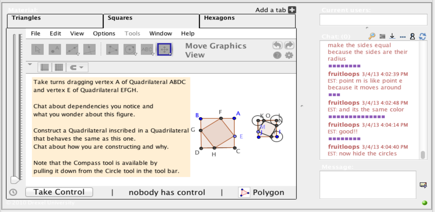
A VMT-mobile environment for tablets, iPads and all web browsers was under development at http://vmtdev.mathforum.org. Here is a view of it:

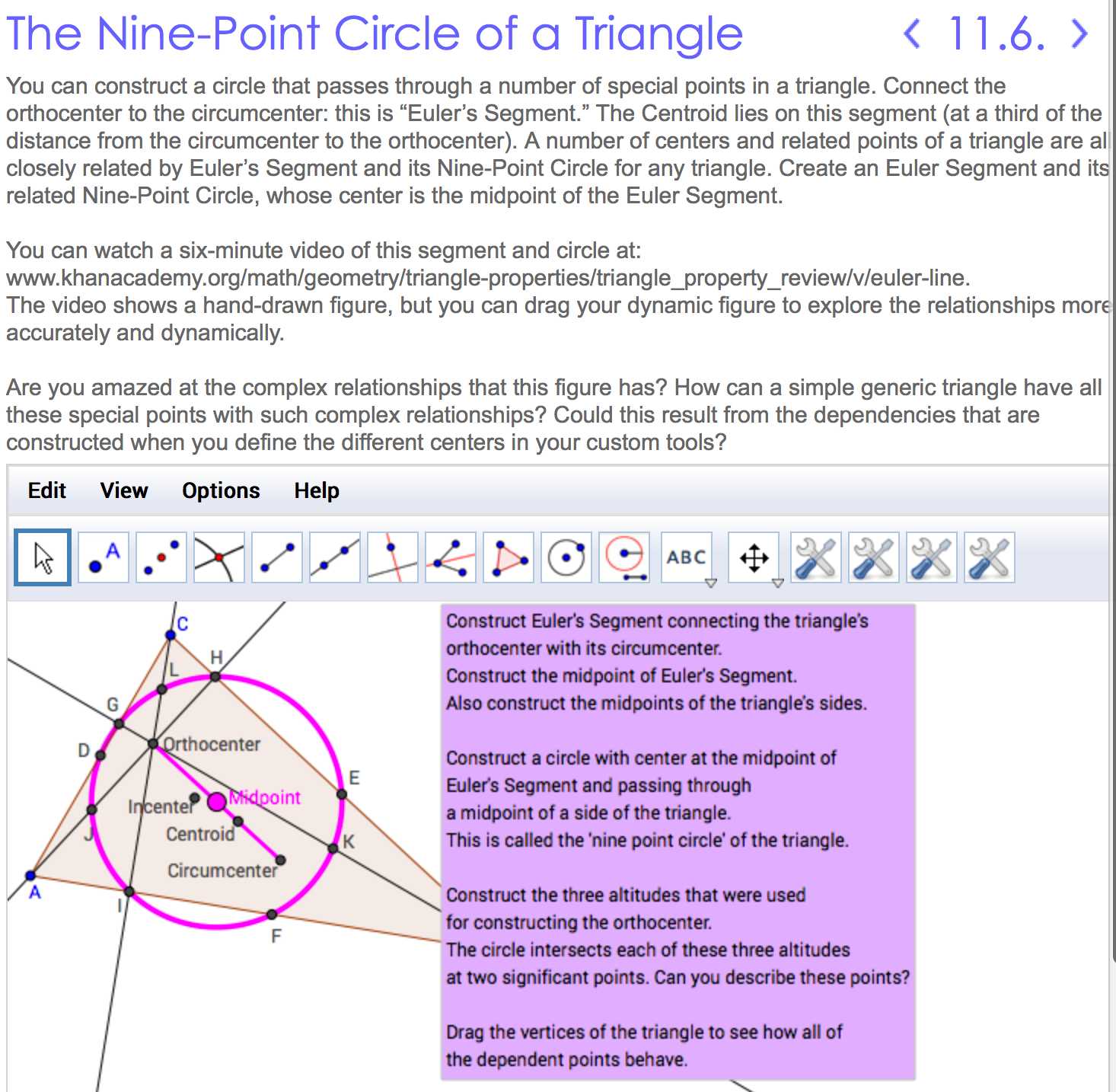
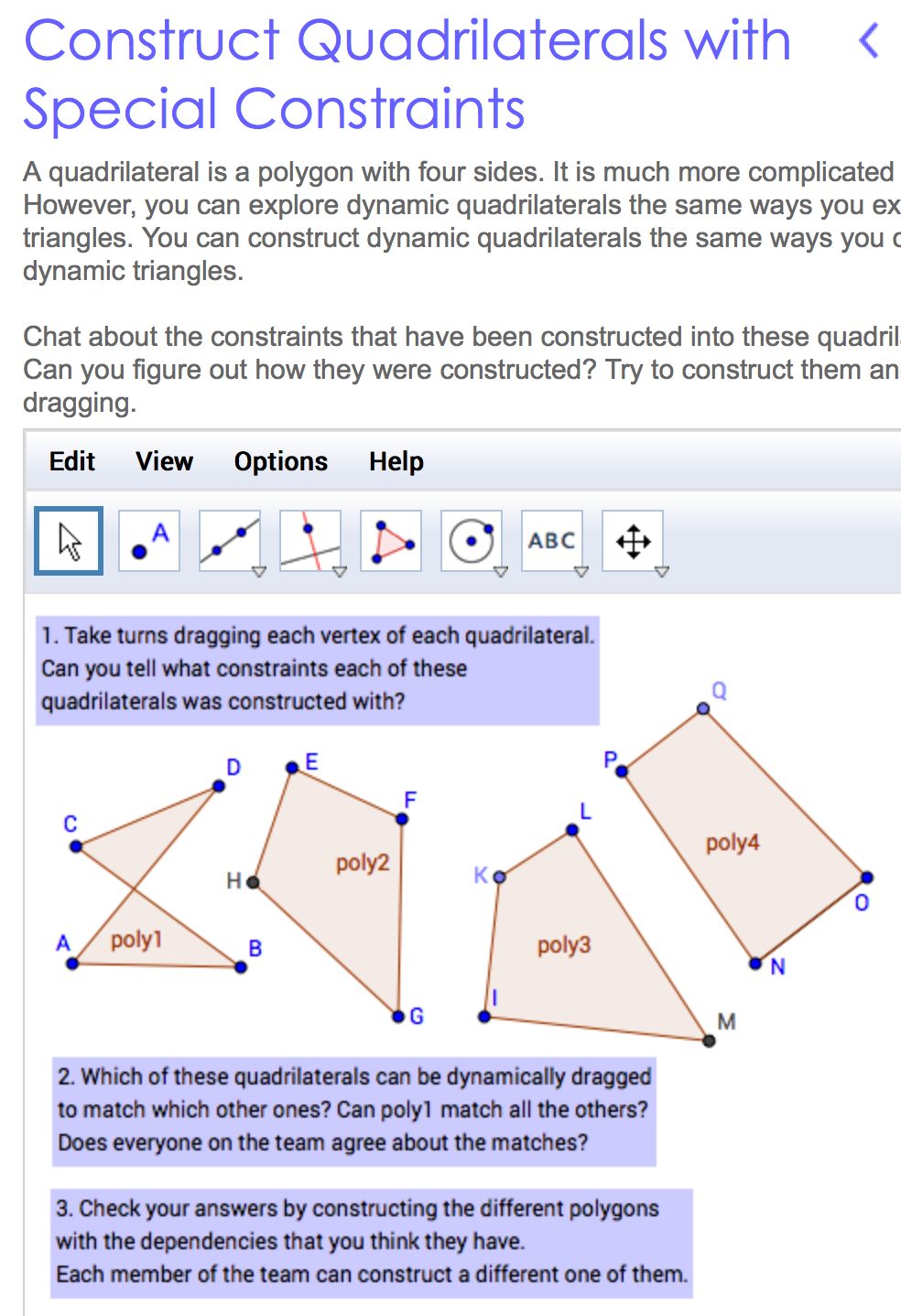
A GeoGebraBook with the VMT curriculum on constructing dependencies in dynamic geometry is available at: http://ggbtu.be/b140867. This is an active book that lets one work on the 50 individual activities in GeoGebra. Unfortunately, it is not multi-user, it is not persistent, there is no chat and it is not instrumented for research or teacher analytics. Here are some views of it:

"Computer-Supported Math Discourse Among Teachers and Students." Award DRL-1118773 from the National Science Foundation Discovery Research K-12 (DR K-12) Program for $1,800,000 over 5 years on September 1, 2011. PI: Gerry Stahl; co-PIs: Stephen Weimar, Jason Silverman, Michael Khoo, Sean Goggins; collaborative proposal with Rutgers, PI: Arthur Powell; other senior personnel: Andrea Forte, Jennifer Rode, Loretta Dicker, Annie Fetter, Tony Mantoan, Jay Scott. Original funding proposal: http://GerryStahl.net/publications/proposals/dr2011.pdf.
The new phase of the VMT Project focuses on promoting significant mathematical discourse. The project is now offering a series of online courses to math teachers to support them in using VMT with their math students. See the course announcement for 2013/14, including course description and stipends available to teachers who take these courses and then use VMT in their classrooms or in after-school groups. (See the description of these courses and stipends for 2012/13.) In the first course, teachers collaborate on a series of dynamic-geometry tasks and then in the second course, the same teachers organize groups of students to collaborate on most of the same topics. The topics are described in course workbooks, "Topics in Dynamic Geometry for Virtual Math Teams."The approach of the topics is based on "Translating Euclid."
As part of this effort, we have integrated a powerful dynamic mathematics application into VMT: the open-source GeoGebra, which integrates geometry, algebra and other forms of math in a dynamic computational environment. We have made GeoGebra multi-user, so that small groups of students can share their mathematical explorations and co-construct geometric figures online. In support of teacher and student use of this collaboration environment, we have developed several versions of a set of activities to systematically introduce people to dynamic geometry, including core concepts from Euclid, standard geometry textbooks and the Common Core Standards for Geometry:Stahl, G. (2012). Dynamic-geometry activities with GeoGebra for virtual math teams. Web: http://GerryStahl.net/elibrary/topics/activities.pdf.
Stahl, G. (2013). Topics in dynamic geometry for virtual math teams. Web: http://GerryStahl.net/elibrary/topics/topics.pdf.
Stahl, G. (2013). Explore dynamic geometry together. Web: http://GerryStahl.net/elibrary/topics/explore.pdf.
A list of all publications related to the VMT project is available at: http://GerryStahl.net/vmt/pubs.html or pdf.
Virtual Math Teams (VMT) is a research project that I have directed since its inception in 2003 at the i-School and the Math Forum at Drexel University in Philadelphia. A group of PhD students, Math Forum staff, interdisciplinary faculty and visiting researchers collaborate on the project. We are developing an online service for math students to meet in small groups online to discuss challenging mathematical topics. We study the usage of the technological environment that we designed for this service, using a method of chat interaction analysis that we have refined. The project is guided by theories of collaborative learning, community knowledge building and group cognition, that we are exploring. A popular report on the VMT Project in the iSchool Bridge provides a good introduction: download it here.
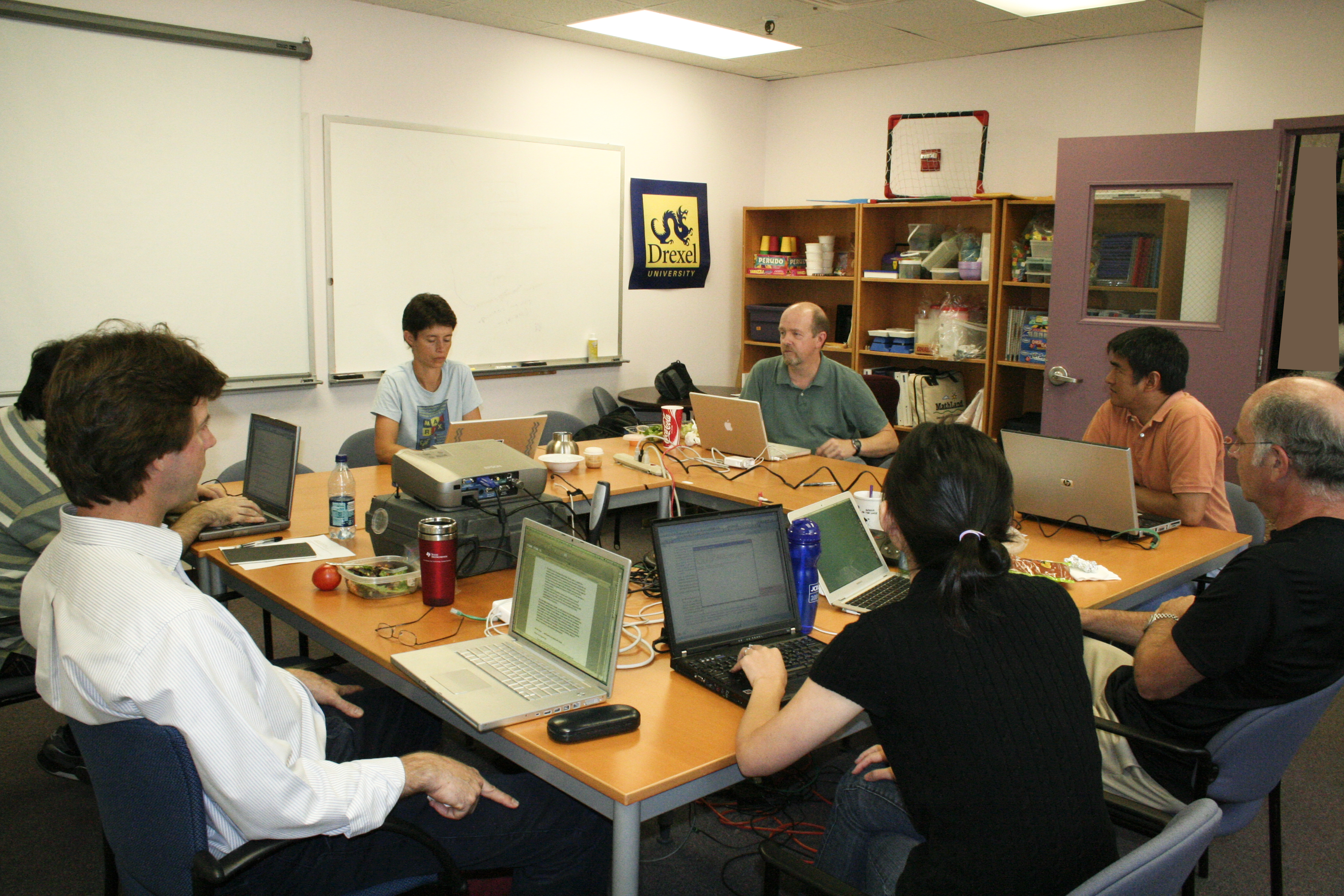
Much of the VMT research takes place in weekly data sessions, as pictured here.
The VMT online environment consists of a Lobby and many chat rooms for the collaborative discussion of math. In the Lobby, you can define your profile and browse the profiles of other people. You can send messages to other people. Mainly, you can see what chat rooms are already defined. Most chat rooms are associated with a math subject and an interesting problem or topic to explore and discuss. The chat rooms include a number of shared whiteboards for drawing and organizing ideas. There are also web browsers. Each chat room has an associated wiki page, where you can share your findings publicly. The VMT wiki is open to the world for reading, but you must register in VMT to post information there. You can also create a new chat room and invite people to it.
If you register and log into the VMT Lobby, you can enter the VMT Sandbox room to explore the functionality available there. You can also join a chat room or even create one to invite people to for collaborative online chats. There is an introduction to VMT for students, parents, teachers and researchers at the Math Forum VMT web page. An extensive list of publications related to the VMT project is available (pdf); the most detailed presentations and reflections on the project are: "Studying Virtual Math Teams" and "Translating Euclid".
After the 6-year IERI grant ended, the VMT project continued through an NSF ALT grant to explore agents in the VMT environment; a list of publications related to the ALT grant is available (pdf). An ONR CKI grant also supported continuing data analysis. During this period, we did a proof-of-concept port of the Open Source dynamic math system, GeoGebra, into the VMT system. This created the first multi-user version of a dynamic mathematics environment.
In September 2011, a 5-year DR K-12 grant revived major work on VMT. For funding details see the web page on Research. This grant allowed us to implement a more robust version of VMT-with-GeoGebra, with Math Forum technical support mainly by Tony Mantoan. Through weekly project meetings, we tried out different curricular approaches and developed a series of activities and tutorials for VMT-with-GeoGebra during 2011-2012.
